
Good Tech Collective
A collective driven to build technology well.
The problem
Technology has given us extraordinary capabilities. AI systems can write, create, persuade, and reason. Digital platforms connect billions of people. Much of this has genuinely improved lives. But that power raises a serious question: do we have the wisdom to build and use tech well? And do our structures even allow for it?
Most tech development optimizes for engagement, growth, and profit — metrics that ignore deeper human needs, long-term consequences, and ecological limits. The result: technology that’s technically impressive and humanly corrosive. More connection, more loneliness. More information, more confusion. More power, less wisdom. More extraction from a planet already under strain.
And there’s something else: we’re spellbound by what technology can do. When a new capability appears — AI that writes, creates, reasons — the question is rarely “should we?” but “how fast can we?” The market rewards adoption, not reflection. Saying no, or even saying “not yet,” feels like falling behind. This makes it harder to be critical about the technology we build, the technology we adopt, and the societal impacts we accept as the cost of progress.
The problem isn’t technology itself. It’s how we build it, the structures we build within, and who we become while building it.
Three Gaps
When I look at why good intentions keep failing to produce good technology, I see three gaps:
Responsible Technology — the implementation gap:
Frameworks for responsible and humane tech exist, but they don’t make it into practice enough. Most people building products have never heard of them. And even when they have, “be ethical” stays abstract. It doesn’t translate into concrete decisions about what to build and how.
Structures & Incentives — the incentive gap:
Many companies are set up in ways that push leaders toward short-term thinking — growth metrics, investor pressure, ownership models that reward extraction over long-term value. The structures are designed to undermine good intentions. From climate tech to social platforms, when wellbeing and profit conflict, the incentive structure usually wins.
Embodied Leadership — the capacity gap:
Even when people know what’s right, and even when the structures allow for it — when the pressure actually hits, can they hold it? Leaders aren’t always equipped to hold their ground under such pressure. Can they pause, stay grounded, make a wise decision instead of a reactive one? That’s a different kind of skill. And it often isn’t developed enough.
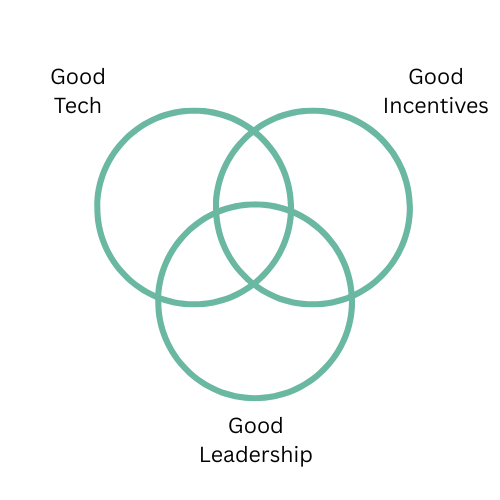
These three gaps are interconnected. Solving one without the others won’t work as effectively as tackling all three.
Good Tech Collective brings together people working across all three — because these problems and their solutions need each other.
The Three Gaps — and Three Responses
1. Responsible Technology — the implementation gap
There’s real progress in responsible tech thinking — from AI ethics and fairness research to humane design and digital well-being. But there’s a disconnect between the people developing these frameworks and the people actually building products. Most teams don’t know what’s out there. And the problems go beyond AI: addictive design patterns, surveillance-based business models, and metrics that optimize for engagement over human flourishing are everywhere in tech.
We need to make responsible technology practical, not theoretical. That means:
- AI systems designed for human wellbeing, not manipulation
- Products built for genuine flourishing, not addictive engagement
- Development processes that account for effects on mental health, democracy, and the living world
- Teams that model healthy relationships with technology themselves
This applies whether you’re building mainstream products or regenerative alternatives. Some of us are trying to make existing tech less harmful. Others are building different models entirely. Both are needed.
—
2. Structures & Incentives — the incentive gap
Even well-intentioned founders get pushed toward short-term thinking by the systems they operate in. When ownership is narrow and incentives focus only on growth, leaders optimize for metrics that don’t reflect real value. They build toward what Cory Doctorow calls “enshittification” — that predictable moment when growth demands making the product worse.
This isn’t hypothetical. In climate tech, in health tech, in social platforms — when the pressure is on and wellbeing conflicts with growth targets, the incentive structure usually wins. Not because people are bad, but because the system is designed that way.
Most people start with good intentions. The structures they operate within often undermine those intentions.
To build good tech, we need structures that support good decisions:
- Ownership models that distribute power and accountability — like steward ownership (e.g., Patagonia, Ecosia), cooperatives, purpose trusts, or commons-based models
- Incentive systems that reward long-term value creation over short-term extraction
- Governance that weighs effects on society, democracy, and ecology — not just shareholders or funders
- Investor and funder education — because the pressure often starts there
—
3. Embodied Leadership — the capacity gap
Here’s what I’ve noticed: you can have the right frameworks and the right structures, and things still fall apart in the moment of decision. Under pressure — when the investor is pushing, the deadline is looming, the competitor is moving faster — what determines the choice is the leader’s capacity.
Most ethics frameworks assume a calm, rational actor weighing options. Real decisions happen in bodies, under stress, with emotions and exhaustion in play. The leader who can stay grounded, pause before reacting, and hold complexity will make different choices than one who’s reactive or disconnected from their values.
I don’t think this is guaranteed to change every decision. But I do think there’s an underexplored opportunity here: for leaders to become more connected — to themselves, to others, to the bigger picture — in ways that make it easier to hold complexity and choose wisely. This is grounded in what we know from cognitive neuroscience and developmental psychology about how humans actually make decisions. It’s not mystical. It’s practical. And it can be developed.
Embodied leadership means building the inner capacity to:
- Make decisions from clarity rather than reactivity
- Hold multiple stakeholders and time horizons simultaneously
- Stay aligned with values when it’s costly to do so
- Lead with strategic intelligence, human wisdom, and ecological awareness
Why these three together
There are people working on responsible tech and AI. People rethinking ownership and governance. People developing wiser, more grounded leaders. People building regenerative alternatives to extractive tech.
These conversations rarely meet. I think they need to.
Good Tech Collective exists at the intersection — where responsible technology, supportive structures, and embodied leadership converge. Not because everyone needs to be an expert in all three, but because they need each other:
- Responsible tech efforts fail when structures push against them
- Good structures aren’t enough if leaders can’t hold complexity under pressure
- Embodied leaders still struggle if the system punishes their choices
The real leverage is where these domains connect.
Who this is for
– Responsible AI practitioners who are tired of frameworks that get ignored when pressure hits — and want to understand why that happens and what to do about it
– Leadership coaches and facilitators who work with tech leaders and know that sustainable change requires more than strategy — it requires capacity
– Founders and executives who started out to build something good and feel the structures around them pulling in other directions — and want peers and support
– People exploring alternative ownership and governance who see that structure shapes behavior, and want to connect with others applying this to tech
– Organizations building regenerative alternatives to extractive tech — and looking for community, not just another network to perform for
– Anyone who’s been sitting at one of these intersections — responsible tech + leadership, ownership + embodied practice, whatever the combination — feeling like the conversations they need aren’t happening
You don’t need to work across all three areas to be part of this. You might focus primarily on one. What matters is recognizing that these domains are interdependent.
The Collective
Why a Collective?
I’m starting this as a collective because I don’t want to do it alone, and because the form should match the content. If everything is interconnected, we should work that way too.
There’s also something broken about how we often approach change — individual consulting, individual coaching, individual efforts. We advise companies one by one but don’t build shared knowledge. We practice mindfulness alone but don’t bring it into community. I want to try something different.
And honestly, this is also a reality check for me. If I can’t find others who resonate with this, maybe the idea doesn’t have legs. I’d rather figure that out together than build something alone that nobody wants.
What the Collective Is
A community of practitioners — consultants, coaches, founders, builders, and organizations — who share these commitments. Some of us focus on responsible AI. Some on ownership structures. Some on leadership development. Some are building regenerative alternatives to mainstream tech. What connects us is the belief that these domains need each other.
We’re early. We’re building this in the open, learning as we go, and looking for others who see it the same way.
Join Us
If this resonates, we’d like to hear from you.
- Practitioners and consultants working in responsible tech, alternative ownership, or leadership development
- Founders and executives trying to build differently and looking for support
- Organizations aligned with these values who want to be part of the network
About
Good Tech Collective was founded by Iris van de Kieft.
After years in the tech industry, my perspective shifted from “tech is awesome” to “wait, we have a lot of responsibility to build tech well” and I became convinced that responsible technology requires more than better principles. It requires a different kind of capacity. And it requires structures that support good decisions rather than undermining them.
I started this collective to find others who see it the same way — and to figure out, together, what it looks like to build truly humane technology.